What New Federal Timber Directives Mean for Wood Processing, Bioenergy, and Domestic Feedstock Supply

By Bill Hagy, Project Director at LEC Partners
In early 2025, two federal actions signaled a notable shift in how the U.S. approaches forest management, timber production, and the utilization of restoration byproducts. While they don’t change market fundamentals overnight, they do create a clearer framework for how federal agencies will prioritize land use efficiency, restoration activity, and domestic wood-processing capacity in the years ahead.On March 1, 2025, the Administration issued Executive Order 14225: “Immediate Expansion of American Timber Production.” The Order frames timber, lumber, paper, and wood-derived energy as essential to national well-being—supporting construction, manufacturing, and the increasingly urgent need to reduce wildfire risk.One month later, USDA released Secretary’s Memorandum 1078-006, formally declaring an emergency on National Forest System (NFS) lands. The memorandum calls for accelerated restoration to address wildfire hazards, protect infrastructure, support rural economies, and strengthen national resilience. A key directive requires the U.S. Forest Service (USFS) to prioritize land-use efficiency, directing future project screening toward initiatives that deliver more value—energy or processing capability—per acre of land impacted.
Where Federal Attention Is Concentrating: The USFS Priority Map
To operationalize these directives, the U.S. Forest Service developed an interactive national map identifying areas most at risk and in need of restoration support:
- High Priority Areas: Regions with high (or above) wildfire hazard or elevated insect/disease pressure
- Very High Priority Areas: Regions with both hazards present simultaneously
Projects located within roughly 250 miles of these zones may qualify as being in “close proximity” under certain federal programs, including the new Timber Production Expansion Guaranteed Loan Program (TPEP).
This mapping does not guarantee feedstock availability but serves as a clear indicator of where restoration activity—and therefore potential restoration byproducts—may expand first.
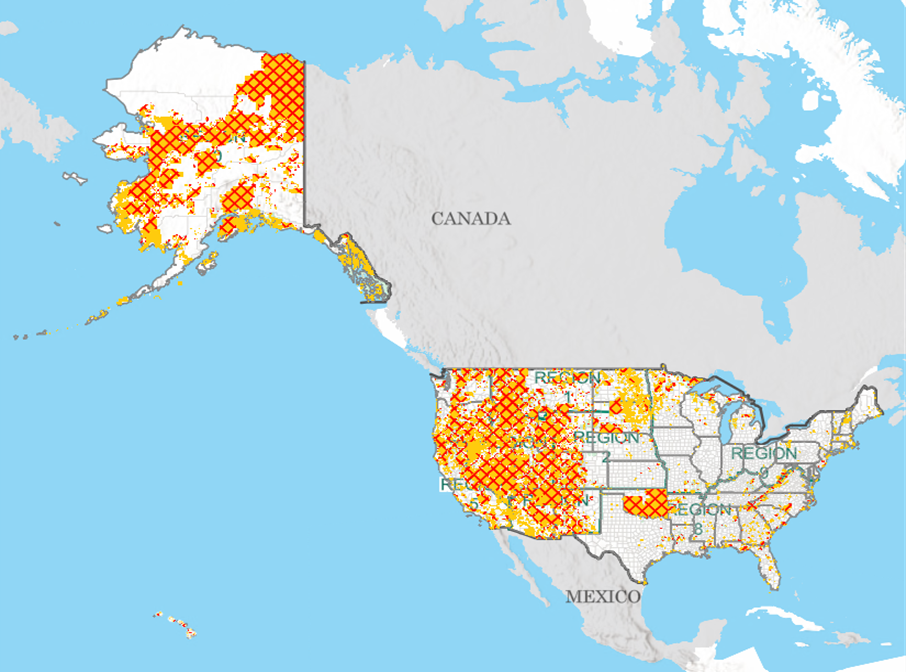
Map URL: USFS Priority Map
U.S. Forest Service map of High Priority and Very High Priority restoration areas, based on wildfire hazard potential and insect/disease risk. Facilities within approximately 250 miles of these zones may qualify as “in close proximity” under the Timber Production Expansion Guaranteed Loan Program (TPEP). Source: U.S. Forest Service.
A New Federal Financing Tool: The Timber Production Expansion Guaranteed Loan Program
To support the goals of the Executive Order and Secretary’s Memorandum, USDA Rural Development—working with the Forest Service—launched the Timber Production Expansion Guaranteed Loan Program (TPEP). This pilot program provides more than $220 million in loan guarantee authority for facilities that establish, reopen, retrofit, expand, or improve sawmills or other wood-processing operations near designated high-priority restoration zones.
TPEP is modeled closely on the Business & Industry (B&I) program, with minimal changes. Its structure includes:
- Up to 90% federal guarantee
- Loan terms up to 30 years
- No guarantee fees, annual fees, or cost share requirements
- No minimum loan amount, with a $25 million maximum
- Refinancing allowed within USDA’s program limits
Eligible processing operations include sawmills, engineered-wood manufacturers, pellet mills, biochar producers, biomass energy facilities, and wood-derived liquid fuel technologies.
Because TPEP is a pilot program, USDA anticipates adjustments and refinements over time as appropriations and program participation evolve.
A Subtle but Important Connection to Domestic Feedstock Priorities
Neither federal directive imposes a domestic-content requirement, but both align with a broader federal trend emphasizing U.S.-sourced feedstocks for low-carbon fuels, bioenergy, and biobased manufacturing. Recent bioeconomy planning efforts—including the broader incentives established under the One Big Beautiful Bill Act of 2025—highlight the need for strong regional biomass supply chains.
TPEP reinforces that direction by linking funding eligibility to areas where restoration activity is expected. This channels investment toward facilities positioned to use local, restoration-generated wood fiber, strengthening domestic feedstock pathways without imposing explicit mandates.
What It Means for Wood Processing and Bioenergy Markets
For sawmills, engineered wood producers, bioenergy developers, pyrolysis and biochar facilities, and other wood-derived manufacturers, several implications emerge:
- Location matters: Proximity to high-priority restoration zones may influence funding eligibility.
- Restoration byproduct users may align well: Projects utilizing forest-restoration residues naturally support federal priorities.
- Land-use efficiency is now a key evaluation factor: Facilities maximizing output per acre may find additional opportunities.
- Regional supply availability may improve: Depending on USFS capacity and state collaboration.
These shifts won’t transform supply chains immediately, but they create a policy environment that supports modernization, capacity expansion, and updated processing infrastructure.
A Measured Step in a Larger Policy Evolution
Viewed together, Executive Order 14225, Secretary’s Memorandum 1078-006, the USFS priority map, and the launch of TPEP represent a coordinated federal approach aimed at improving forest health while strengthening domestic wood-processing capabilities.
For companies operating near these zones, understanding how current or future operations align with USDA’s new criteria may be increasingly important as additional funding tools emerge.
This LEC Partners article was later republished in Biofuels Digest.
Read the syndicated version.
About the Author
Bill Hagy is a Project Director at LEC Partners, where he advises clients across the bioeconomy on federal funding mechanisms, biomass supply chains, USDA loan guarantees, and project development strategy. He also leads Bill Hagy Consulting LLC and serves on the Advisory Board of the Biorenewable Deployment Consortium. Recognized by Biofuels Digest for his contributions to the field, he brings decades of experience in federal rural infrastructure programs and emerging wood-to-energy markets.
About LEC Partners
LEC Partners is a Cambridge, MA–based consulting firm specializing in bioenergy, biobased materials, biotechnology, feedstock strategy, and project development. For more than 30 years, the firm’s experts have supported companies, investors, and developers with technical due diligence, engineering and financial reviews, regulatory guidance, and federal funding navigation.
FAQ
What are the two new federal timber directives discussed in this article?
The article focuses on Executive Order 14225, which directs an immediate expansion of American timber production, and USDA Secretary’s Memorandum 1078-006, which declares an emergency on National Forest System lands and requires the Forest Service to prioritize land-use efficiency in project review.
How does the USFS priority map affect wood-processing and bioenergy projects?
The map highlights areas with the greatest wildfire hazard or insect/disease pressure. Projects located within about 250 miles of these high-priority regions may qualify as being in “close proximity” for federal programs like TPEP, and may see more restoration-derived biomass become available over time.
What is the Timber Production Expansion Guaranteed Loan Program (TPEP)?
TPEP is a USDA pilot program offering more than $220 million in federal loan guarantees to support sawmills and wood-processing facilities. It helps fund reopening, expanding, or modernizing facilities that can process wood—including restoration byproducts—within high-priority regions identified by USFS.
What types of facilities are most likely to benefit from these federal timber directives?
Facilities such as sawmills, engineered-wood manufacturers, pellet mills, biochar producers, biomass energy facilities, and companies producing wood-derived liquid fuels may benefit, particularly if they are located near designated restoration zones.
What should companies near high-priority restoration zones consider doing next?
Companies may want to assess how their projects align with TPEP’s proximity, land-use efficiency, and restoration byproduct utilization criteria. Reviewing feedstock strategies and determining whether the project sits within the 250-mile zone can help identify eligibility for federal programs.
Talk With an Expert
LEC Partners brings together more than 150 bioeconomy specialists to help clients reduce risk and move projects forward with confidence. Whether you need technology assessment, due diligence, or support from planning through startup, we can help.
Further Reading
LEC Insights
Current Federal Funding Opportunities
A frequently updated overview of federal funding programs shaping the bioeconomy.
Biomass Baseload Energy Opportunity
How baseload biomass systems support resilience, rural economies, and decarbonization.
Biofuels Feasibility Expert
How feasibility experts evaluate feedstocks, process routes, and financial viability.
Other Trusted Industry Sources
IEA: Transport Biofuels Outlook
Global trends, policies, and deployment forecasts for transport biofuels.
DOE: Bioenergy Technologies Office
U.S. federal programs advancing biofuels, feedstocks, and low-carbon energy systems.
IRENA: Bioenergy and Biofuels
International insights on bioenergy technologies, markets, and their role in the energy transition.

Have some questions?
Not sure where to start?
Let's start a conversation. We're here to help you navigate
the bioeconomy with confidence.