Digital Twins in Fermentation Scale-Up: What Works?
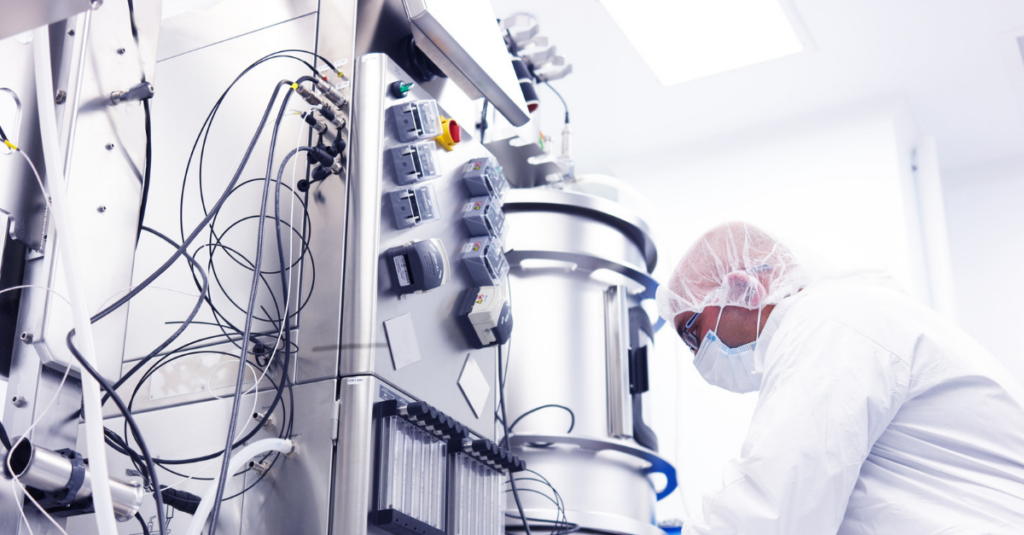
A model that fits pilot data can still miss the constraints of a larger fermenter. For developers and investors, digital twins in fermentation offer a way to examine those gaps by connecting process predictions with operating data.
The useful question is which decision the model can improve: planning pilot trials, adjusting operating conditions, or testing a production forecast. The evidence needed for each is different.
What Makes a Process Model a Digital Twin?
NIST describes manufacturing twins as synchronized virtual models. Here, the term means a process-specific representation kept connected to operating data for a defined purpose, such as monitoring, prediction, or control.
The underlying model might use engineering relationships, measured patterns, or both. Hybrid approaches combine first-principles descriptions with data-driven estimates where the process is difficult to characterize directly.
An offline simulation can inform the design of a future facility. That isn’t the same as maintaining a twin of an operating process, and useful simulation results alone don’t demonstrate an operational system.
Where Digital Twins in Fermentation Can Help
The examples below focus primarily on aerobic microbial fermentation.
Oxygen Transfer, Mixing, and Broth Behavior
Avoiding oxygen limitation requires sufficient transfer capacity under the intended operating conditions. Agitation, aeration, pressure, vessel geometry, and broth properties all affect that capacity. A single dissolved-oxygen reading cannot establish that conditions are adequate throughout the vessel.
Spatially resolved approaches, including compartment models, can investigate concentration gradients and compare operating strategies. These tools can support scale-up without being digital twins themselves.
Changing broth properties add complexity, particularly in filamentous fungal processes. A model calibrated only to early-batch conditions may miss later changes in viscosity, mixing, and oxygen transfer.
Monitoring and Operating Decisions
Connected models can estimate process states and support control decisions using process analytical technology (PAT). A NIST-listed biopharmaceutical study demonstrates integration of process measurements and predictive control in a testbed, rather than commercial microbial scale-up.
An advisory tool and a system authorized to adjust feed rates need different operating safeguards. Neither should be judged by prediction accuracy alone.
What the Fermentation Research Demonstrates
A June 2026 study in the Journal of Industrial Microbiology and Biotechnology examined hybrid modeling in 550-liter fungal fermentations.
Researchers varied operating conditions within batches to fit an oxygen-transfer correlation using two fermentations, with a third used for validation. This covered nine operating combinations without assigning an entire fermentation to each combination.
Those three runs weren’t the study’s total experimental workload. Other fermentation data supported development of its biological and viscosity models.
The practical finding is that targeted experiments can make model development more efficient. It is not evidence of a commercially deployed twin, and the authors’ reported calibration fit should not be confused with independent predictive performance.
Validation Has to Match the Decision
NIST’s work on model credibility treats validation and uncertainty assessment as lifecycle activities tied to intended use, not a one-time approval.
Define acceptable prediction error for the decision before testing. Use operating runs excluded from model development, and reassess the evidence when equipment, strains, feedstocks, or measurement systems change.
Sensor calibration, sampling frequency, and missing data deserve the same scrutiny as model equations. For control applications, specify when operators intervene and what happens if data or predictions become unreliable.
A model should help identify which pilot tests matter most, not substitute for the evidence those tests provide.
Better Fermentation Doesn’t Always Mean Better Economics
Consider a hypothetical feeding strategy that raises final titer by 15% but extends fermentation time by 20%. Assuming equal final working volumes and otherwise comparable conditions, the simplified titer-per-hour measure falls by about 4%.
That calculation excludes turnaround and downstream recovery. It does not establish the effect on annual saleable output, which could move differently once complete batch cycles and plant constraints are considered.
The commercial assessment should connect process predictions with annual production, product quality, utilities, recovery, and cost per kilogram. A change can be worthwhile because it lowers costs, even without increasing output.
Optimizing the fermenter while creating a bottleneck in downstream recovery isn’t much of a victory.
Five Questions Before Relying on a Forecast
- Which decision will it improve?
Specify the operating or capital decision, not just the variable being predicted. - What evidence is independent?
Separate calibration data from testing, and identify the scales and conditions actually evaluated. - How dependable are the measurements?
Examine calibration, sampling, missing data, and estimates of unmeasured variables. - What does uncertainty cost?
Test its effect on throughput, recovery, utilities, and manufacturing economics. - Who acts on the result?
Define operator authority, operating limits, and fallback procedures.
How LEC Partners Evaluates Scale-Up Assumptions
In a mycoprotein investment review, LEC Partners examined harvest concentrations and assumptions for batch, drop-and-fill, and continuous operation. An independent productivity model helped identify incorrect output projections, informing the client’s decision to decline the investment.
A separate precision-fermentation engagement compared production scales through techno-economic modeling and examined upstream and downstream cost drivers, including recovery, purification, and consumables.
These published engagements demonstrate forecast scrutiny and economic analysis, rather than digital twin implementation. They show two ways to test commercial claims: challenge projected output against operating evidence and examine the costs behind the production plan.
Speak with an Expert
Preparing a pilot campaign or reviewing commercial production forecasts? LEC Partners can help assess the process assumptions, operating evidence, and economic sensitivities that should inform your next decision.
Further Reading
Insights from LEC Partners
Due Diligence of Mycoprotein Producer Investment
Testing fermentation assumptions and commercial output forecasts.
Techno-Economic Analysis of Animal-Free Protein Production
Examining production scale, recovery, and manufacturing costs.
Trusted Industry Resources
Hybrid Modeling for Industrial Fermentation Processes
Pilot-scale research on experimental design and oxygen-transfer modeling.
NIST: Credibility Consideration for Digital Twins in Manufacturing
Validation, uncertainty, and confidence in model-based decisions.
Written by the LEC Editorial Team

Have some questions?
Not sure where to start?
Let's start a conversation. We're here to help you navigate
the bioeconomy with confidence.